
Imagine you’re about to execute a complex cross-chain DeFi position from your browser: supply liquidity on Arbitrum, route a swap through an automated market maker, and approve a new contract — all while juggling ledger confirmations and gas on two chains. One wrong approval or one misunderstood gas estimate, and dollars vanish or transactions deadlock. For US-based traders and teams who run frequent, high-value operations, the wallet in your browser is not a convenience — it is a front-line risk control.
This article compares Rabby’s browser extension (the Rabby Chrome/Chromium extension) to other EVM wallets from the perspective of power users: which mechanisms reduce exposure to smart-contract risks, where Rabby materially changes the decision calculus, and what limits remain that should shape operational practice.
How Rabby works under the hood: mechanisms that matter
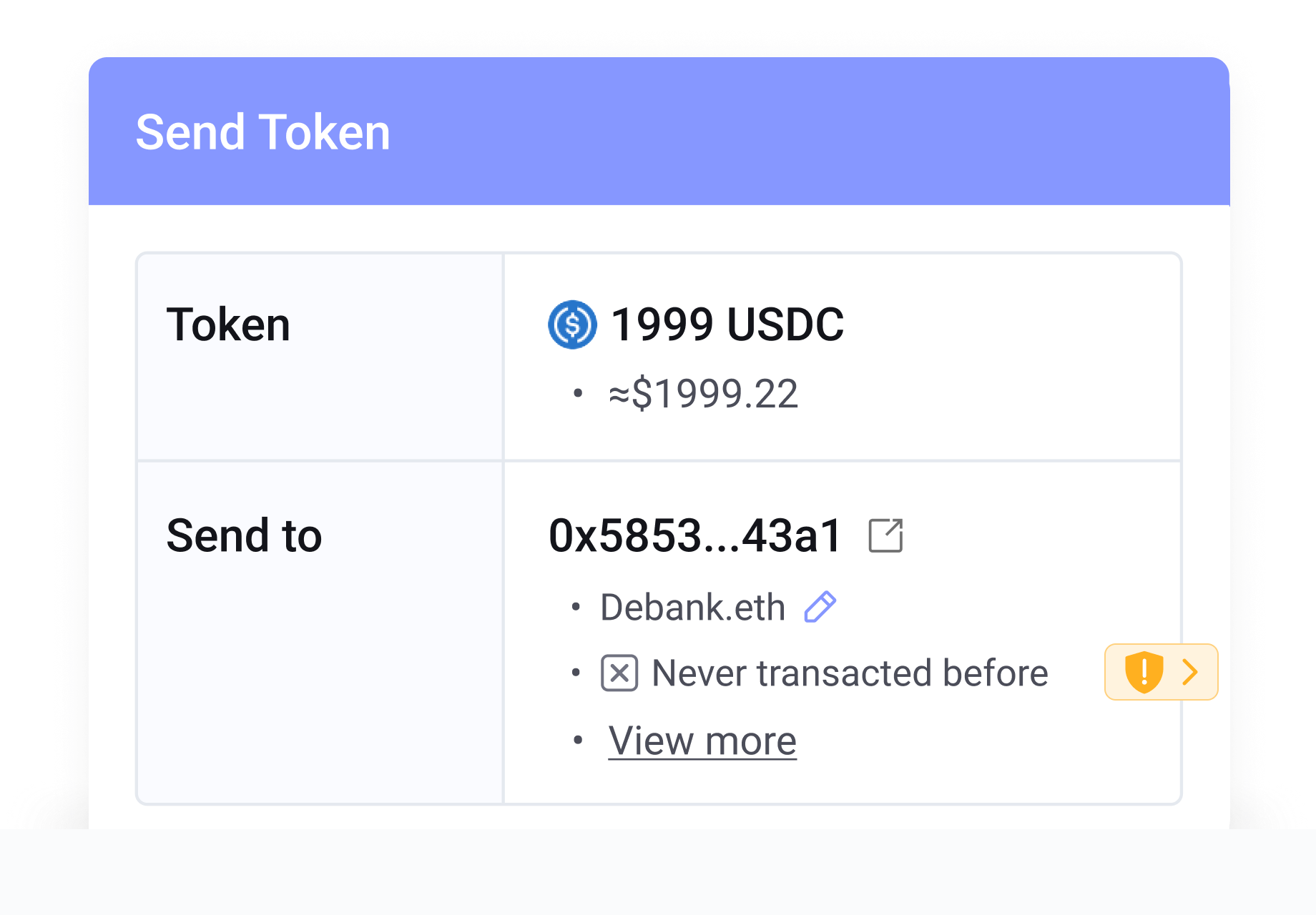
At its core Rabby is a non-custodial, multi-chain wallet built by DeBank. Mechanistically it layers several defensive functions on top of the basic signing flow found in any extension wallet. The most significant are transaction simulation and a pre-transaction risk scanner. Before the wallet asks you to sign, it runs the transaction in a sandboxed environment and displays the estimated token balance changes and fee costs. That step converts a transaction from an opaque byte sequence into a near-human-readable delta: what leaves your balance, what arrives, and how much native gas will be consumed.
In parallel, Rabby applies signature-level heuristics and blacklists to flag suspicious targets: previously exploited contracts, large approval requests, and non-existent recipient addresses. It also exposes an approval revocation interface so users can rescind unlimited token allowances — a high-leverage control when interacting with many dApps.
Operationally important: Rabby supports over 90 EVM-compatible chains and offers automatic network switching based on dApp context. For high-frequency cross-chain flows this removes a common source of friction and human error: users don’t have to manually change networks before signing. Rabby also supports hardware wallets (Ledger, Trezor and others) and integrates with multi-sig and custody solutions (Gnosis Safe, Fireblocks, Amber, Cobo), which is critical for institutional workflows.
Head-to-head trade-offs: Rabby vs. MetaMask and others
When you compare Rabby to common alternatives like MetaMask, Trust Wallet, or Coinbase Wallet, two functional differences explain most of Rabby’s appeal for the advanced user: built-in transaction simulation and richer pre-signing risk signals. MetaMask provides a standard signing prompt and relies on external explorers or manual inspection; Rabby attempts to translate the signing prompt into an actioned simulation that shows token deltas and fee breakdowns. Practically, that reduces the probability of “blind signing” errors.
But the advantage is not absolute. Rabby’s simulation depends on accurate node responses and up-to-date contract metadata. If a dApp uses obfuscated or novel contract logic, simulation can miss off-path behavior. Similarly, Rabby’s revocation tools are powerful, but revoking approvals is a transaction that costs gas and, in some cases, may require interacting with proxy contracts — an operational cost that matters when managing tens of live approvals.
Security incidents show both strengths and limits. In 2022 a Rabby-associated swap contract was exploited for ~$190,000; the team froze the contract and compensated users, then increased audits. That episode illustrates a broader point: wallets reduce certain classes of user risk (blind approvals, accidental network mismatches) but cannot immunize users from every smart-contract vulnerability or from the economic incentives that produce hacks.
Decision framework for different power-user roles
To translate features into decisions, use a simple three-axis heuristic: value at risk (VaR), operational frequency, and threat model. If VaR is low (small, infrequent trades), convenience and ease of fiat on-ramp may dominate — Rabby currently lacks a built-in fiat on-ramp, so that favors wallets tightly integrated with exchanges. If VaR is high (large positions, institutional custody, multi-sig needs), Rabby’s simulation, hardware support, and integrations with enterprise custody solutions become decisive.
For teams with operational frequency (many transactions per day), automatic network switching and cross-chain gas top-up reduce task-time and error rates. For users worried about targeted phishing or state-level threats, the open-source codebase and hardware wallet integrations improve auditability and reduce single-point compromise risk. No wallet is a panacea: even with Rabby, the best mitigation for a targeted adversary is disciplined key management, air-gapping, and multisig.
Where Rabby alters common misconceptions
Misconception: “All browser wallets are functionally the same.” Reality: transaction simulation and proactive approval scanning change the risk equation by turning binary signing decisions into informed choices. That matters particularly when interacting with composable DeFi protocols where a single approval can grant contract-level access to many tokens.
Misconception: “Open-source means secure.” Reality: OSS increases transparency and the chance of third-party audits, but it does not guarantee that all code paths are reviewed or that novel exploits won’t be found. Rabby’s open-source MIT license reduces trust friction, but users must still account for supply-chain and runtime risks (malicious updates, compromised browser environment).
Operational checklist: practical steps when using Rabby in a US context
– Use hardware wallets for high-value accounts and enable Rabby’s hardware integrations to keep private keys offline during signing. Hardware mitigates browser-level malware but adds UX friction.
– Always read Rabby’s simulated token delta before signing complex transactions. If the delta differs from the dApp UX, pause: either the dApp or the simulation may be wrong.
– Regularly run the approval revocation tool. For pockets of dormant approvals, revocation reduces long-tail exposure, but budget for gas costs accordingly.
– For institutions, prefer Rabby flows that integrate with multi-sig custody (Gnosis Safe) to split operational risk. Test cross-chain gas top-ups in low-value runs to validate pipeline behavior before scaling.
To learn more technical specifics about Rabby and installation steps, consult the project overview here: https://sites.google.com/cryptowalletextensionus.com/rabby-wallet/
Limits, open questions, and what to watch next
Limits you must accept. Rabby does not include an in-wallet fiat on-ramp, so US users who need on-ramps will still rely on exchanges or third-party providers. There is no native staking module, so delegated-staking workflows must be handled externally. Transaction simulations are powerful but not omniscient: exotic contract logic, time-dependent effects, and oracle-fed behavior can evade static or local simulation.
Key signals to monitor: (1) how Rabby expands its simulation coverage and whether it begins to incorporate formal verification tools; (2) adoption among institutional custody providers beyond current integrations, which would change its risk profile for enterprise users; (3) improvements in revocation UX to reduce gas overhead for bulk allowance revocations. Any of these developments would make Rabby more attractive for large, frequent traders.
FAQ
Q: Does Rabby prevent every smart-contract exploit?
A: No. Rabby reduces many common user-level risks (blind signing, accidental approvals, wrong-network errors) by simulating transactions and flagging suspicious contracts. However, it cannot eliminate vulnerabilities in the smart contracts you interact with or protect against runtime-exploits in the wider ecosystem. Simulations rely on node data and contract metadata, which can be incomplete.
Q: Can I use Rabby with a Ledger or Trezor?
A: Yes. Rabby supports a wide range of hardware wallets (Ledger, Trezor, Keystone, CoolWallet, GridPlus, BitBox02). For high-value operations, pairing Rabby’s pre-signing analysis with a hardware device significantly reduces attack surface.
Q: How does Rabby’s transaction simulation differ from relying on a block explorer?
A: A block explorer shows executed transactions and contract source, but Rabby runs a pre-signing execution simulation against the relevant chain state to estimate token deltas and gas. This turns a raw transaction into a predicted outcome before funds move, which is more actionable than retrospective exploration. That said, simulation accuracy depends on up-to-date state and node behavior.
Q: Is automatic network switching safe?
A: It reduces human error by selecting the appropriate chain for a dApp automatically. The trade-off is that users must trust the wallet to choose correctly; malicious or manipulated dApp contexts could prompt unintended switches. Combine automatic switching with deliberate inspection of the simulated transaction to retain control.